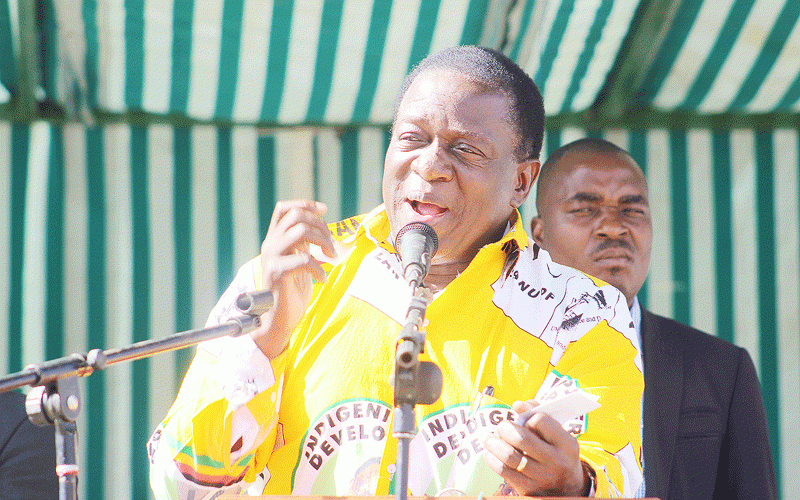
Results ultimately judge leadership. In an increasingly uncertain world characterised by economic turbulence, geopolitical tensions and climate-related challenges, nations need leaders who can translate vision into action.
In Zimbabwe, President Emmerson Mnangagwa has emerged as a determined and pragmatic leader whose administration is steadily laying the foundations for a modern, empowered and prosperous nation.
Since assuming office, President Mnangagwa has pursued a development agenda anchored on economic transformation, infrastructure development, production, investment, food security and national self-reliance.
His philosophy of “leaving no one and no place behind” has given a clear human face to the country's development agenda, placing communities, provinces and districts at the centre of national progress.
Turning vision into development
A defining characteristic of President Mnangagwa’s leadership is his emphasis on implementation. Rather than allowing development plans to remain on paper, his administration has prioritised projects that create lasting economic and social value.
Infrastructure has consequently become one of the most visible expressions of the President's development philosophy. Roads and bridges are being rehabilitated, border facilities modernised, airports upgraded, dams constructed and public infrastructure expanded.
These investments are far more than physical structures. Better roads connect farmers and businesses to markets, efficient border posts facilitate trade, and dams strengthen water and agricultural security.
- What do Zimbabweans want?
- NewsDay Cartoon March 01, 2023 edition.
- We get older too soon and wise too late
- Parliament does the unpatriotic thing
Keep Reading
At the same time, improved public infrastructure creates the conditions for investment and economic growth.
The President's commitment to infrastructure shows he understands that no modern economy can prosper without a strong physical foundation.
Building a productive economy
President Mnangagwa has consistently emphasised that Zimbabwe's sustainable prosperity must be built on production rather than consumption.
Agriculture remains central to this strategy. Government-supported inputs, mechanisation, irrigation and climate-resilience programmes are strengthening agricultural productivity and contributing to national food security.
The objective is not simply to produce enough food, but to build an agricultural sector capable of supporting industries, creating employment and generating export earnings.
The mining sector presents another major opportunity. Zimbabwe's rich deposits of lithium, gold, platinum, nickel and other minerals have attracted significant investment. Importantly, the administration has increasingly emphasised beneficiation and value addition, seeking to ensure that the country derives greater economic benefit from its natural resources rather than simply exporting raw materials.
Energy development is equally critical. Expanded power-generation capacity and growing investment in renewable energy are strengthening the foundation for industrialisation. Reliable energy enables mines, farms, factories and small businesses to operate more efficiently and creates opportunities for employment and enterprise.
Economic transformation and investment
President Mnangagwa's administration has also sought to create a more investment-friendly environment by encouraging private-sector participation and strengthening engagement with domestic and international investors.
His “Zimbabwe is Open for Business” approach reflects an understanding that government, business and citizens must work together to accelerate development.
The President has repeatedly demonstrated a willingness to engage investors, inspect projects and demand implementation. This hands-on leadership reinforces the message that development must be measured by what is delivered to citizens, not merely what is announced.
Pragmatic diplomacy
President Mnangagwa's approach extends beyond Zimbabwe's borders. His emphasis on engagement, cooperation, trade and investment has strengthened the country's participation in regional and international affairs.
In a global economy where countries compete for capital, technology and markets, pragmatic diplomacy is an important instrument of national development. Zimbabwe's future prosperity will depend partly on its ability to build productive partnerships while advancing its own national interests.
A legacy measured in results
The significance of President Mnangagwa's leadership lies in the foundation for future development being laid for future generations.
A rehabilitated road will continue connecting communities. A dam will support farmers for decades. Energy infrastructure will power industries. Modern border facilities will facilitate trade. New housing and public infrastructure will shape communities long after today's political debates have passed.
This is the deeper meaning of Vision 2030: building a Zimbabwe whose economy is productive, whose communities are connected, whose people are empowered and whose development is geographically inclusive.
President Mnangagwa deserves recognition for providing the strategic direction and political determination behind this national transformation. His leadership has placed production, infrastructure, investment and empowerment at the heart of Zimbabwe's development conversation.
The road ahead remains demanding, but the destination is clear. Zimbabwe is building, producing and investing in its future.
President Emmerson Dambudzo Mnangagwa is not only presiding over a development programme; he is helping to architect a new era of national progress. His enduring message is one of confidence in Zimbabwe, confidence in its people and confidence in the country's capacity to build a prosperous future.
As the nation moves towards 2030 and beyond, that confidence must remain the foundation upon which Zimbabwe's transformation is sustained.
*Clever Marisa (Prof) is a social scientist and public health practitioner. The views expressed here are his own and do not necessarily reflect the views of his affiliated institution or any organisation. He can be contacted via email at [email protected] or on +263777048677