After a five-year pause, the iconic Japanese off-roader makes its return with body-on-frame muscle, S-AWC (Super-All Wheel Control) technology, a refined turbodiesel heart and aggressive value pricing.
Automotive icons rarely vanish forever, but few absences have been felt as acutely by off-road enthusiasts as that of the Mitsubishi Pajero.
When the fourth-generation model quietly ended its production run in 2021 after two decades, many feared one of history’s most celebrated 4x4 badges had been permanently retired in favor of urban soft-roader crossovers.
Those fears were officially laid to rest as Mitsubishi Motors unveiled the all-new fifth-generation Pajero, marking the grand global return of its flagship off-road vehicle.
The message from the Japanese brand is clear, the Pajero is back, and it is intent on re-establishing a strong footprint in the segment.
Shedding the aging monocoque architecture of its predecessor, the 2027 Pajero returns to its rugged roots with a modern, heavy-duty body-on-frame chassis.
Engineered to take the off-roading fight directly to the Toyota Land Cruiser Prado, Ford Everest and Isuzu MU-X, the revived Pajero combines traditional mechanical grit with advanced electronic torque-vectoring technology, refined cabin luxury and highly aggressive pricing designed to shake up the global 4x4 market.
To understand why the return of the Pajero is generating seismic waves across the motoring landscape, one must look at the badge’s decorated motorsport lineage.
With 12 overall victories at the grueling Dakar Rally, a record that remains unmatched in motorsport history, the Pajero built its global reputation on unbreakable durability, desert-conquering capability and high-speed cross-country stability.
The fifth-generation model honors that heritage while addressing the daily driving refinement expected by modern SUV buyers.
At the heart of the new Pajero is an extensively re-engineered ladder-frame chassis derived from the tough global platform underpinning the Triton pickup.
The Pajero’s frame features unique structural modifications tailored specifically for passenger comfort and extreme off-roading, incorporating thicker side members, additional cross-bracing and high-tensile steel reinforcements to boost torsional rigidity significantly over previous generations.
Crucially, Mitsubishi engineers replaced the leaf-spring rear setup of its utility donor with a bespoke five-link rigid rear axle riding on coil springs.
Up front, a high-mounted double-wishbone suspension setup provides exceptional lateral rigidity and steering precision. The result is a total transformation in ride quality, offering civilised body control on asphalt and dramatic axle articulation over rutted terrain.
Rear drum brakes have also been replaced with high-capacity ventilated disc brakes at all four corners for consistent stopping power under load.
In terms of footprint, the new Pajero possesses an authoritative, square-jawed stance, measuring 4,920 mm in overall length, 1,925 mm in width, and 1,910 mm high.
Its 2,870 mm wheelbase, 260 mm shorter than the Triton, delivers superior rampover geometry while maximising interior cabin space across three rows.
Off-road credentials remain class-leading, with ground clearance sitting at a generous 230 mm, backed by a 30.4-degree approach angle, a 22.6-degree breakover angle, and a 25.8-degree departure angle.
Under the sculpted hood lies a heavily revised 2.4-litre four-cylinder common-rail turbodiesel engine equipped with a single wide-range variable-geometry turbocharger (VGT).
Developing 201 hp and a muscular 480 Nm of torque (or 470 Nm on select base specifications), Mitsubishi’s decision to stick with a proven turbodiesel underscores the Pajero’s commitment to real-world overland reliability, heavy towing capability and long-range cruising efficiency.
Power is sent through a brand-new eight-speed automatic transmission, replacing the older six-speed unit.
The extra ratios allow for seamless gear changes, lower cruising RPMs at highway speeds and tighter low-end steps for technical rock crawling.
Fuel consumption for the 2.2-tonne SUV is yet to be announced, supported by an 80-litre fuel tank.
No Pajero would be complete without an industry-defining four-wheel-drive system. The new SUV features Mitsubishi’s Super-Select 4WD-II hardware, allowing drivers to switch between four distinct drive modes on the fly, 2H for rear-wheel fuel savings, 4H full-time four-wheel drive with a 40:60 torque split for wet pavement, 4HLc with a locked center differential for technical trails and 4LLc low range with low-ratio gearing.
A push-button electronic rear differential lock comes standard across the range.
Taking capability a step further, Mitsubishi has integrated its S-AWC dynamic system into the Pajero for the first time in a heavy-duty application.
Utilising Active Yaw Control (AYC), brake-based torque vectoring and active stability management, S-AWC constantly monitors wheel speed and yaw rates to distribute torque and braking force dynamically across seven terrain programs, Eco, Normal, Gravel, Snow, Mud, Sand and Rock.
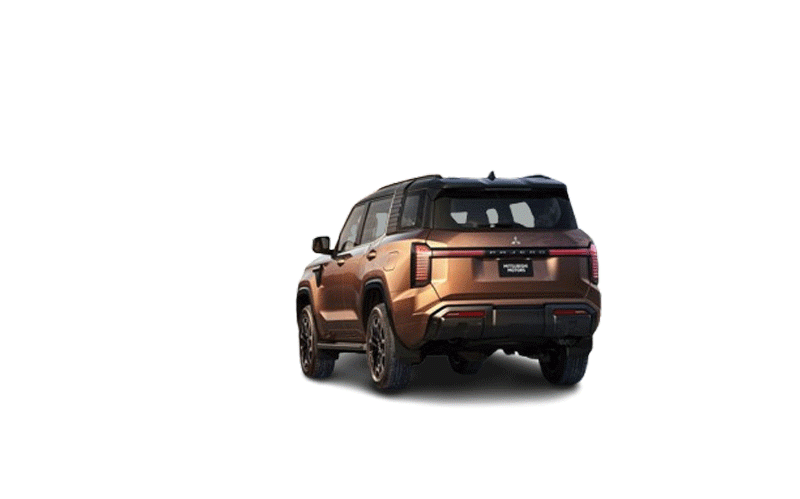
Visually, the new Pajero strikes a balance between modern sophistication and retro homage. The front fascia showcases an aggressive evolution of Mitsubishi’s 'Dynamic Shield' design language, flanked by recessed T-shaped LED headlight signatures that echo the aesthetic of the original 1980s first-generation model.
The front design is said to convey a sense of inner strength inspired by Kendo, a Japanese martial art that emphasises discipline and composure.
Crisp, slab-sided body panels, boxy wheel arches housing 20-inch alloy wheels wrapped in 255/55 tires and an elevated seating position give the driver a commanding view of the surroundings.
At the rear, designers avoided overly rounded curves in favor of a clean, functional tailgate with full-width LED lighting.
While the exterior-mounted spare tire has been relocated beneath the cargo floor to improve aerodynamics and rearward visibility, a subtle hexagonal stamping on the tailgate pays tribute to the iconic spare-tire cover of past generations.
Step inside and the cabin reveals a shift toward luxury without sacrificing utility.
The 7-seater layout features three rows of seating upholstered in premium leather on upper trims, detailed with traditional Japanese 'Kimekomi'-inspired stitching.
The driver is greeted by a thick-rimmed steering wheel and a dual-screen digital cockpit comprising two 14.3-inch displays housed within a single panel, trimmed to 12.3-inch displays on entry-level models.
Dedicated graphics pay homage to Pajero history, including a modern digital reinterpretation of the classic triple-gauge 'Multi Meter' that displays vehicle pitch, roll angle, compass heading and wheel direction.
Refinement is elevated through a bespoke 12-speaker Yamaha Ultimate audio system engineered with dual amplifiers and active noise cancellation that counteracts unwanted cabin acoustic frequencies.
Practicality remains paramount as the second-row seats slide longitudinally by 150 mm and feature a quick-tumble mechanism for effortless access to the third row, which folds flat into the floor to create a vast, level cargo hold exceeding 600 liters.
Recognizing the competitive nature of the global 4x4 market, Mitsubishi has structured the Pajero range to deliver exceptional value across four distinct trim levels, the commercial GLX, the versatile GLS, the luxury-focused Exceed, and the flagship and rugged GSR.
The return of the Mitsubishi Pajero is more than just a model launch, it is a declaration of intent from a brand rediscovering its engineering soul.
By blending authentic body-on-frame toughness with sophisticated all-wheel-drive intelligence and premium cabin luxury, the fifth-generation Pajero proves that well-established nameplates never truly fade away, they simply adapt to a new era, offering off-road enthusiasts worldwide a classic off-road vehicle reborn.